Free guide

Natives mistaken for weeds

Some good local plants look scruffy, spread, or look like a weed. These are the ones I see pulled out by mistake, and how to tell them apart.

Three checks before you pull: wait for flowers or fruit; look closely at the leaves (count leaflets, check veins, turn a leaf over); snap a photo and check PlantNET or iNaturalist. Still unsure? Leave it for now. A weed won't take over in a week.

Look-alike pairs

Scurvy weed vs trad

✓ Native: keep it

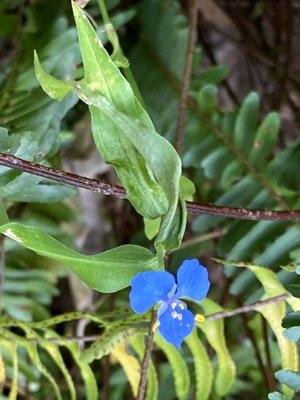
Commelina cyanea
Photo: Richard Fuller, CC0 1.0, iNaturalist

Scurvy weed

Commelina cyanea

  • Deep blue flowers, spring to autumn
  • Leaves 2–7 cm long, fairly narrow (5–15 mm wide), pointed
  • Leaf sheath has short hairs at the mouth
  • Local to damp forest and woodland. PlantNET says it can be "sometimes weedy" because it spreads, but it's a great groundcover to keep

PlantNET description · In the plant finder

✗ Weed: pull it

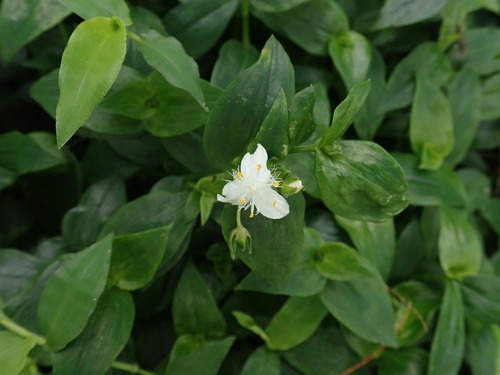
Tradescantia fluminensis
Photo: Harry Rose, CC0 1.0, iNaturalist

Trad

Tradescantia fluminensis

  • White 3-petalled flowers with fluffy white hairs in the middle (on the stamens)
  • Shinier, broader leaves (1–2.5 cm wide) on juicy stems that swell at the joints
  • Forms dense, smothering mats in shade
  • From South America; regrows from the tiniest bits

How to control trad

Quick tell: Blue flower = keep. White flower = trad. No flowers? Native Oplismenus grasses can look like trad too, so wait for flowers or ask me before pulling.

Weeping grass vs panic veldtgrass

✓ Native: keep it

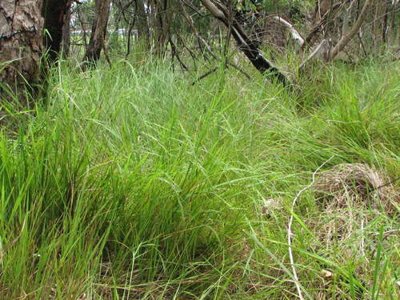
Microlaena stipoides
Photo: guymer, CC BY 4.0, iNaturalist

Weeping grass

Microlaena stipoides

  • Slender, tufted grass to 0.7 m
  • Delicate seed heads 7–17 cm that droop or "weep", with long, fine bristles
  • Flowers most of the year
  • Local native, and my top pick for a native lawn in the shade

PlantNET description · In the plant finder

✗ Weed: pull it

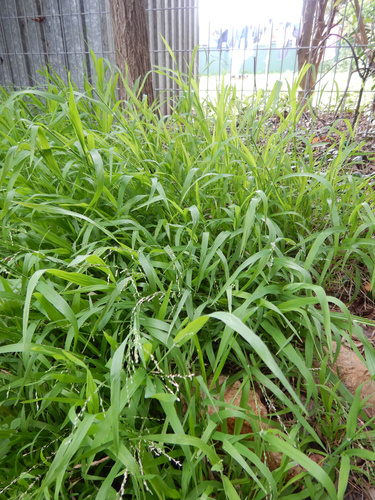
Ehrharta erecta
Photo: Jon Sullivan, CC BY 4.0, iNaturalist

Panic veldtgrass

Ehrharta erecta

  • Tufted, soft, bright green grass to 0.6 m
  • Broad, floppy leaves 2–15 mm wide
  • Seed head stands upright, open and bristle-free
  • South African weed of moist, shady sites

How to control panic veldtgrass

Quick tell: Nodding, bristly seed heads = keep. Upright, open, bristle-free seed heads = veldtgrass.

Native raspberry vs blackberry

✓ Native: keep it

Rubus parvifolius
Photo: Ian Rainbow, CC BY 4.0, iNaturalist

Native raspberry

Rubus parvifolius

  • Low scrambling shrub, stems to about 1 m
  • Mostly 3 (sometimes 5) small leaflets, 1–4 cm, wrinkly on top and white and woolly underneath
  • Small pink to red petals
  • Ripe fruit red, about 10 mm across

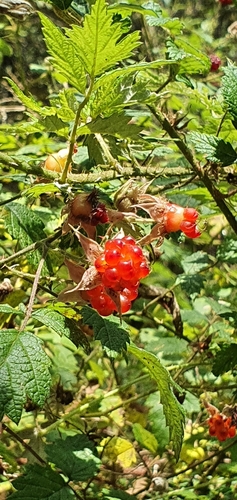
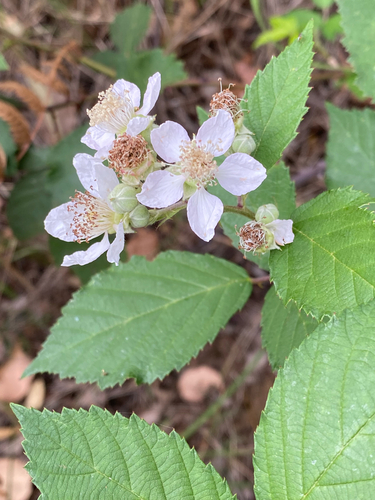
✗ Weed: pull it

Rubus fruticosus
Photo: smathichong, CC BY 4.0, iNaturalist

Blackberry

Rubus fruticosus agg.

  • Big, arching, prickly canes forming thickets
  • Leaves of 3–5 larger toothed leaflets
  • White or pink flowers 2–3 cm across
  • Berries ripen from red to shiny black. A State priority weed

Quick tell: Ripe red fruit and small pink flowers = native raspberry. Ripe black fruit and big flowers = blackberry.

Wonga wonga vine vs cat's claw creeper

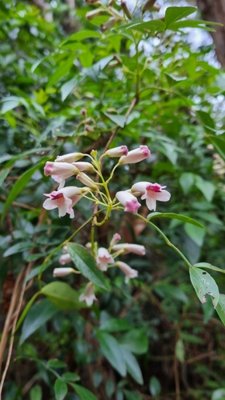
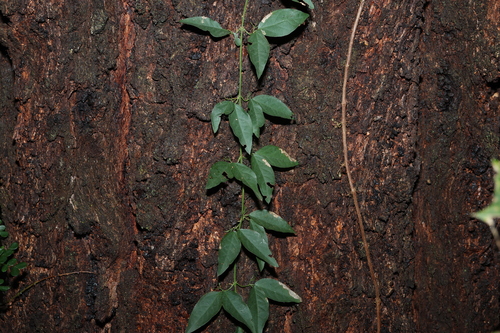
✓ Native: keep it

Pandorea pandorana
Photo: Ian Rainbow, CC BY 4.0, iNaturalist

Wonga wonga vine

Pandorea pandorana

  • Woody climber; leaves have 3–9 leaflets (young plants: 8–17 small toothed leaflets)
  • Clusters of small tubular flowers 1–2.5 cm, whitish, often with purple blotches or stripes in the throat
  • Flowers June–December
  • Local to damp gullies and rocky spots

PlantNET description · In the plant finder

✗ Weed: pull it

Dolichandra unguis-cati
Photo: Greg Tasney, CC BY-SA 4.0, iNaturalist

Cat's claw creeper

Dolichandra unguis-cati

  • Leaves of just 2 leaflets with a 3-pronged, claw-like tendril between them
  • Big yellow trumpet flowers 4–8 cm in spring
  • Carpets the ground and climbs trees; masses of tubers
  • A State priority weed, and officially listed as a key threat to NSW nature

How to control cat's claw creeper

Quick tell: Count the leaflets. Two leaflets plus a claw = cat's claw. Three or more leaflets and no claws = wonga vine.

Old man's beard vs jasmine & japanese honeysuckle

✓ Native: keep it

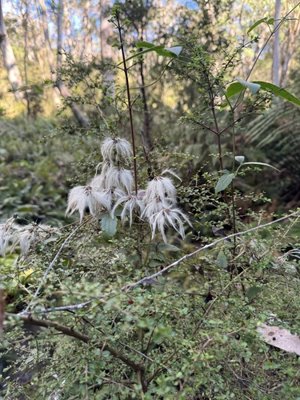
Clematis aristata
Photo: Sockrosma, CC BY 4.0, iNaturalist

Old man's beard

Clematis aristata

  • Strong climber to 6 m in damp, sheltered spots
  • Leaves mostly of 3 leaflets, usually toothed
  • White star-like flowers, usually Sept–Dec
  • Followed by fluffy, feathery seed heads (the "beard")

PlantNET description · In the plant finder

✗ Weed: pull it

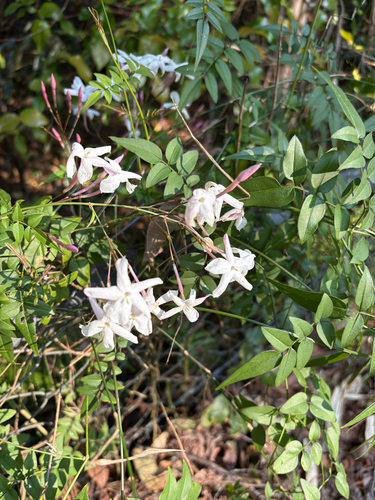
Jasminum polyanthum
Photo: Bryce Watts-Parker, CC BY 4.0, iNaturalist
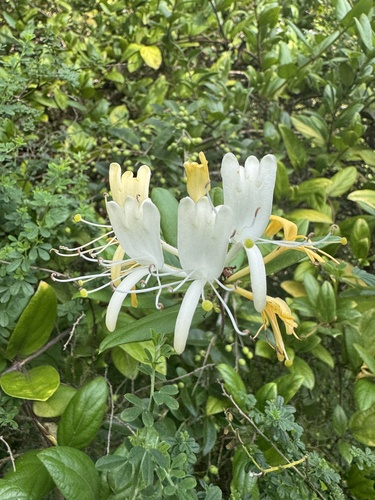
Lonicera japonica
Photo: Caleb Catto, CC BY 4.0, iNaturalist

Jasmine & Japanese honeysuckle

Jasminum polyanthum, Lonicera japonica

  • Jasmine: leaves of 5–9 leaflets; scented flowers white on top, pink underneath
  • Japanese honeysuckle: simple oval leaves in opposite pairs; paired, two-lipped white flowers that age to yellow; black berries
  • Both smother shrubs and small trees

How to control jasmine · How to control japanese honeysuckle

Quick tell: Three toothed leaflets and fluffy seed heads = native clematis. Pink buds or yellowing paired flowers = weed.

Sweet sarsaparilla vs madeira vine

✓ Native: keep it

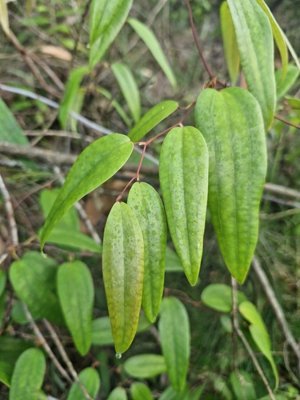
Smilax glyciphylla
Photo: ronavery, CC BY 4.0, iNaturalist

Sweet sarsaparilla

Smilax glyciphylla

  • Light climber to about 5 m, not prickly
  • Lance-shaped leaves 4–10 cm with 3 prominent veins, pale and whitish underneath
  • Climbs with coiling tendrils
  • Shiny black berries 5–8 mm

PlantNET description · In the plant finder

✗ Weed: pull it

Anredera cordifolia
Photo: Will Cornwell, CC BY 4.0, iNaturalist

Madeira vine

Anredera cordifolia

  • Fleshy, bright green, heart-shaped leaves
  • Knobbly potato-like tubers hanging along the stems
  • Drooping spikes of fragrant cream flowers in late summer–autumn
  • State priority weed; tubers fall and regrow

How to control madeira vine

Quick tell: Three parallel veins and tendrils = native. Fleshy leaves and tubers on the stems = Madeira vine. Name trap: "false sarsaparilla" is another name for the native purple coral pea, Hardenbergia violacea.

Wombat berry vs bridal creeper

✓ Native: keep it

Eustrephus latifolius
Photo: Greg Tasney, CC BY-SA 4.0, iNaturalist

Wombat berry

Eustrephus latifolius

  • Light vine to 6 m
  • Leaves 3–10 cm, dull on both sides, with all veins equally distinct
  • Small pink, mauve or white flowers, spring–summer
  • Round orange fruit 10–20 mm that splits to show black seeds, each with a white fleshy coat

PlantNET description · In the plant finder

✗ Weed: pull it

Asparagus asparagoides
Photo: Carl Ramirez, CC BY 4.0, iNaturalist

Bridal creeper

Asparagus asparagoides

  • Shiny, oval "leaves" on wiry stems (they're really flattened stems)
  • Scented greenish-white flowers, late winter–early spring
  • Red berries; thick mat of tubers below
  • Grows in autumn–winter, dies back in summer

How to control bridal creeper

Quick tell: Orange fruit = wombat berry. Red berries and glossy winter growth = bridal creeper. The native scrambling lily looks similar too: it has one strong vein down the middle of the leaf and black fruit.

Milk vine vs moth vine

✓ Native: keep it

Marsdenia rostrata
Photo: Greg Tasney, CC BY-SA 4.0, iNaturalist

Milk vine

Marsdenia rostrata

  • Twining vine of moist, shady forest
  • Leaves shiny on top, pale green underneath
  • Smaller, creamy flowers
  • Long, narrow seed pods

PlantNET description · In the plant finder

✗ Weed: pull it

Araujia sericifera
Photo: Caleb Catto, CC BY 4.0, iNaturalist

Moth vine

Araujia sericifera

  • Dull, grey-green, arrow-shaped leathery leaves, whitish underneath
  • Larger creamy-white to pink tubular flowers, Nov–March
  • Big choko-like pods 6–10 cm
  • Milky sap; poisonous, so wear gloves

How to control moth vine

Quick tell: Choko-shaped pods = moth vine. Native silkpods (Parsonsia) also look similar: small yellow flowers and cigar-shaped pods.

Small natives worth keeping

I often see these weeded out of North Shore lawns and beds. All are native to the Sydney area.

Oplismenus imbecillis
Photo: Greg Tasney, CC BY-SA 4.0, iNaturalist

Creeping beard grass

Oplismenus imbecillis

Weak, trailing grass to 0.3 m with soft leaves up to 7 mm wide; grows in shady forest. Can look like trad when not flowering. A soft native "lawn" under trees.
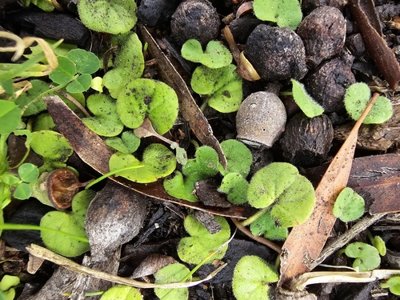
Dichondra repens
Photo: Josh, CC BY 4.0, iNaturalist

Kidney weed

Dichondra repens

Creeping, with kidney-shaped leaves 5–25 mm and tiny greenish-yellow flowers. PlantNET calls it a "weed of lawns", but it is native and makes a lawn alternative for low-traffic areas.
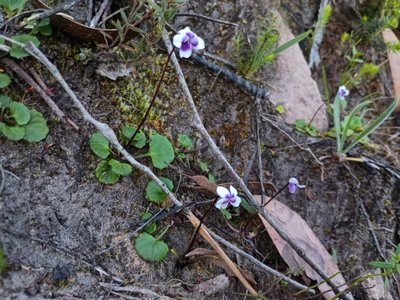
Viola hederacea
Photo: grampianshiker, CC BY 4.0, iNaturalist

Native violet

Viola hederacea

Tufts of kidney-shaped to round leaves; mauve-and-white flowers in spring and summer; sheltered, moist spots.
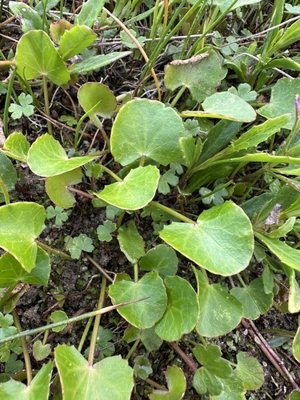
Centella asiatica
Photo: Matt Berger, CC BY 4.0, iNaturalist

Swamp pennywort

Centella asiatica

Creeping plant that roots as it goes; rounded leaves 1–4 cm on long stalks; tiny pink, purple or white flowers. Great for soggy spots.
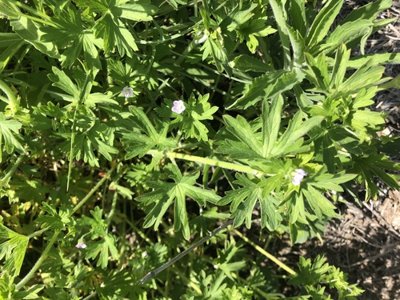
Geranium solanderi
Photo: Michael Fox, CC BY 4.0, iNaturalist

Native geranium

Geranium solanderi

Hairy, deeply lobed, round leaves; small pink flowers. A close relative, G. homeanum, has smaller pink-to-white flowers. Both are local.
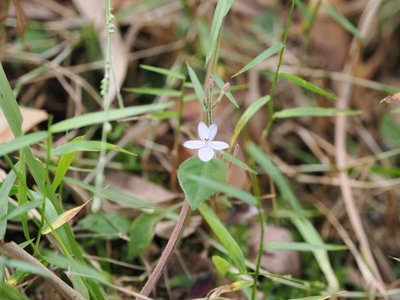
Pseuderanthemum variabile
Photo: Lucas Christofides, CC BY 4.0, iNaturalist

Pastel flower

Pseuderanthemum variabile

Small herb 15–30 cm for shade; white to mauve flowers Dec–May. Self-seeds, and feeds the caterpillars of the Varied Eggfly and Leafwing butterflies.
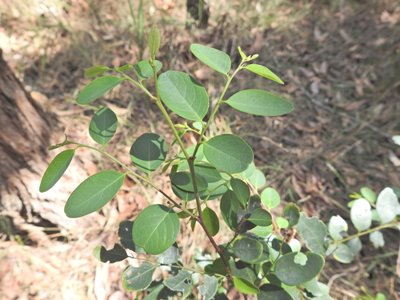
Breynia oblongifolia
Photo: Scott W. Gavins, CC BY 4.0, iNaturalist

Coffee bush

Breynia oblongifolia

Shrub to 3 m with single leaves (not split into leaflets) that alternate up the stem, and round berries (cassia can look similar). Birds eat the berries.

Rule of thumb: small, soft plants that pop up in shady beds and lawns are often natives finding their way home. Leave a test corner to flower and photograph a flower and a leaf before you spray or pull a patch. If it's native, you've got a groundcover you didn't have to buy.

✓ Do this

  • Wait for flowers or fruit
  • Photograph a flower and a leaf
  • Leave a test corner to grow

✗ Not that

  • Spray a whole patch blind
  • Pull what you can't name
  • Assume "spreads" means "weed"

Native, but can be weedy: sweet pittosporum

Pittosporum undulatum is genuinely native to the North Shore. But PlantNET says that in the Sydney district it can be "a troublesome invader in disturbed sclerophyll forest" (our typical gum-tree bush), and councils note it as invasive outside its natural home.

My advice: an established tree is fine to keep and gives dense shelter for small birds. Don't plant new ones next to bushland, and pull seedlings where they crowd other natives. Council tree rules apply to larger specimens.

Fishbone fern: not native here

On the North Shore, fishbone fern is almost certainly the weed. PlantNET treats fishbone fern (Nephrolepis cordifolia) as native in NSW only north of the Clarence River; around Sydney it is a garden escape. No Nephrolepis fern is native to the Sydney region.

My advice: dig out the runners and tubers (see weeds to worry about) and replace with local ferns such as prickly rasp fern (Doodia aspera), gristle fern (Blechnum cartilagineum) or common maidenhair (Adiantum aethiopicum).

Did you know?

"Australian native" doesn't always mean "local". Umbrella tree (from North Queensland) is treated as an environmental weed in NSW, and some wattles from other regions, such as Cootamundra wattle, are on council lists of unwanted trees. For gardens next to bushland, choose plants local to your own soil type.

Not sure what's in your garden? I can walk your garden with you, point out the natives worth keeping and the weeds to go, and send you a shortlist of local plants. See native garden advice →

Sources: PlantNET (NSW Flora Online) species descriptions; NSW WeedWise profiles ("similar looking plants"); RF Horticulture's local native plant list; NSW WeedWise (umbrella tree) and council tree lists (Cootamundra wattle). Printable version: Natives Often Mistaken for Weeds (PDF).

DIY it

What you'll need:

  • A phone camera: photograph the leaf, stem and flower before you pull anything
  • The photos on this page, or the printable look-alikes handout
  • Patience: if unsure, leave it and check

Get in touch for a quote

Not sure what's weed and what's worth keeping? On a visit I walk the garden with you, point out both, and can do the weeding for you.

Quotes for garden care, weeding, planting and installation. No travel fee on the North Shore.

CallGet a quote